
South African Communications Association Conference
#SACOMM2026
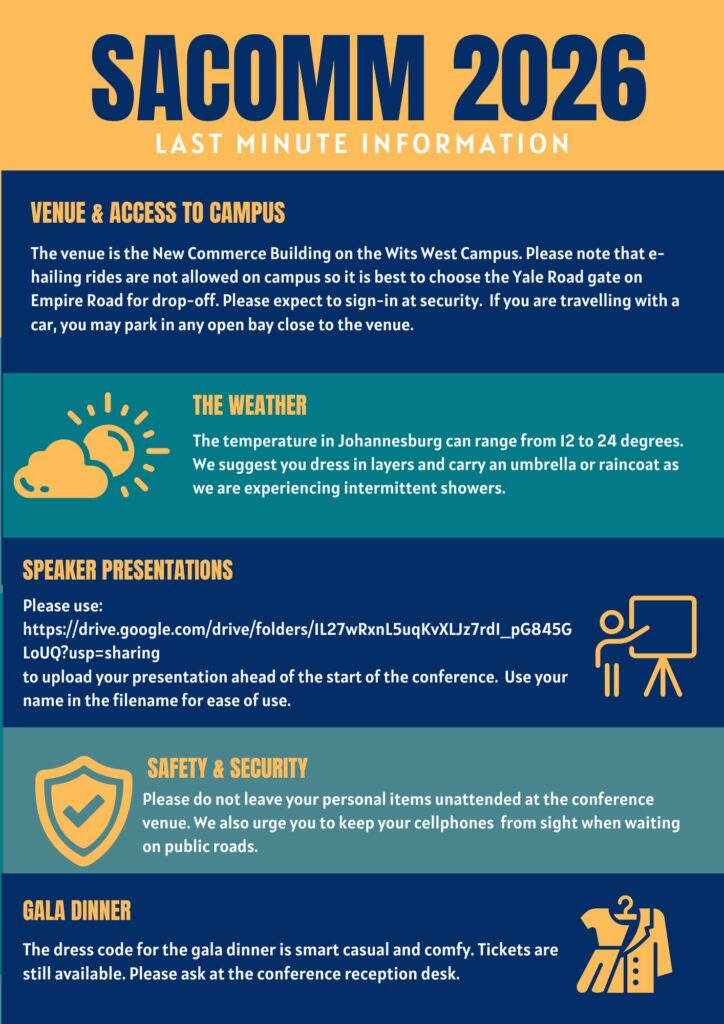
The 2026 South African Communications Association conference (SACOMM) will take place at Wits University from 9 – 11 September: Asserting the Human in the Time of Technofeudalism: Global South Perspectives.
Conference events include:
- A pre-conference programme for emerging scholars on 8 September.
- A conference gala dinner on 10 September.
- A post-conference Digimethods workshop limited to 20 participants on 12 September.
Programme and Speakers
Click here to view and download the 2026 programme.
Speaker Presentations – Google Drive
Speakers are encouraged to upload their presentations to this Googe Drive folder ahead of the conference. Please use your name as the file name for ease of use.
Travel Information
The venue for the conference is: The New Commerce Building, Wits University West Campus, via Empire Road, Braamfontein, Johannesburg.
Recommended hotels include:
- Holiday Inn, Rosebank
- Tsogo Southern Sun, Rosebank
- The Parkwood Lodge Boutique
- Courtyard Hotel Rosebank
- Garden Court Milpark
Recommended suburbs to stay in:
- Rosebank
- Parktown North
- Illovo
- Melville
- Westcliff
- Forest Town
Getting to the venue
By car: There are public parking areas at the university in walking distance to the venue. Use this map as a reference.
By Train: You may use the Gautrain and get off at Johannesburg Park Station which is located at Corner Smith and Wolmarans Street. The venue is approximately two kilometres away from Johannesburg Park Station and is adequately served by a direct bus service, e-hailing, and taxis which can be used to access the Empire Road university entrance.
By Taxi and e-Hailing: Multiple e-hailing and taxi companies are available in the city. E-hailing services are not permitted to access the campus and once dropped off at the Empire Road main gate, you will need to walk to the venue.
By Bus: There are different bus routes around the city that will take you to stations around university. You will have to communicate with the bus driver and let them know that you are going to Wits University in Braamfontein, and they will give you direction on which bus you have to take. You can take the Rea Vaya to the Empire Road station.
CONTACT US
For additional assistance, write to [email protected]
About the 2026 theme
The theme for 2026 is Asserting the Human in the Time of Technofeudalism: Global South Perspectives.
The contemporary media environment is characterised by the increasing influence of platforms in what has come to be known as the platform economy. Scholarly debates shaped by this reality, including the political economy of the media, address whether capitalism is now dead or whether we live in a world marked by a different form of capitalism. Those who argue that capitalism is now dead (e.g., Varoufakis 2023) point to what may be called the refeudalisation of society, in which ‘rent’ is the new profit.
The rise of a platform economy, which accumulates capital through rent, in the form of ‘workers’ renting space or experience on platforms such as Google, Facebook, Netflix, etc., is said to have overtaken the significance of capital accumulation through the production of tangible goods. Thus, they argue that we now live in a technofeudal era. However, others (see Gilbert 2024) argue that capitalism is not necessarily dead, but that we live in a ‘new regime of accumulation’ in which profit is derived from investing in the creation, maintenance, and innovation of platforms on which individuals and organisations pay rent. In other words, as Morozov (2022) argues, it is more persuasive to hold on to the argument that capitalism is simply reinventing itself.
These arguments open up avenues for analyses of the current media and information environment. In a context where a few platforms significantly determine access to information, markets, cultural visibility, and even social existence, it is necessary to consider the impact on real humans. The impact is unequal across the world. Just as capitalism grows through the accumulation of excess value resulting in acute inequalities, technofeudalism, or the new regime of capital accumulation, is lived through unequal connectivity, infrastructural dependency, digital colonialism, and the intensification of platform governance over culture, labour, and knowledge production.
The race to AI dominance further exacerbates the inequalities brought by the new regime of capital accumulation. The Global South is particularly affected due to its long-standing experience of constrained and subordinate role-play in the Global economy. There is a need for analytical and potential proposals to reclaim the discourse and valorise and assert the experiences and homegrown solutions of people in the Global South.
This conference theme invites scholars to interrogate how the human is being redefined and reasserted in the emerging order of technofeudalism or regimes of capital accumulation. Further, scholars are invited to explore innovations that acknowledge this emerging order but chart possible ways, especially for the Global South, to centre the human while staying relevant and possibly chart new paths for capital accumulation with the human in mind.
Submissions include papers on –
• Technofeudalism and media innovation for sustainability
• Journalism practice and technofeudalism debates
• Technofeudalism and its implications for strategic communication
• Re-centering the human in communicative activities in a technofeudal system
• Decolonial perspectives on technofeudalism
• Agency in the Global South and the charting of new directions in a technofeudal system
• Re-imagining communities and access to information in a technofeudal system
• The human in the university curriculum and media training
• Health communication in a technofeudal system
Submissions may come from a range of disciplines, including but not limited to communication studies, media studies and journalism, communication education and advocacy, and strategic communication.
Abstracts will be peer-reviewed, and accepted papers will be presented at the conference either in a traditional presentation format or as part of a panel.
Abstract submissions are now closed.
About SACOMM
The main activity of SACOMM is to arrange an annual conference which is hosted by a different South African tertiary education institution or university each year.
These conferences bring together communication academics and students from around Southern Africa and the world. The SACOMM conference provides a regular platform for academic researchers to discuss new research within the sphere of communications scholarship, as well as the pressing challenges and difficulties, faced in the communications field on the continent, and has also traditionally been a space for academics, and communications professionals and practitioners, to meet and engage on these issues.